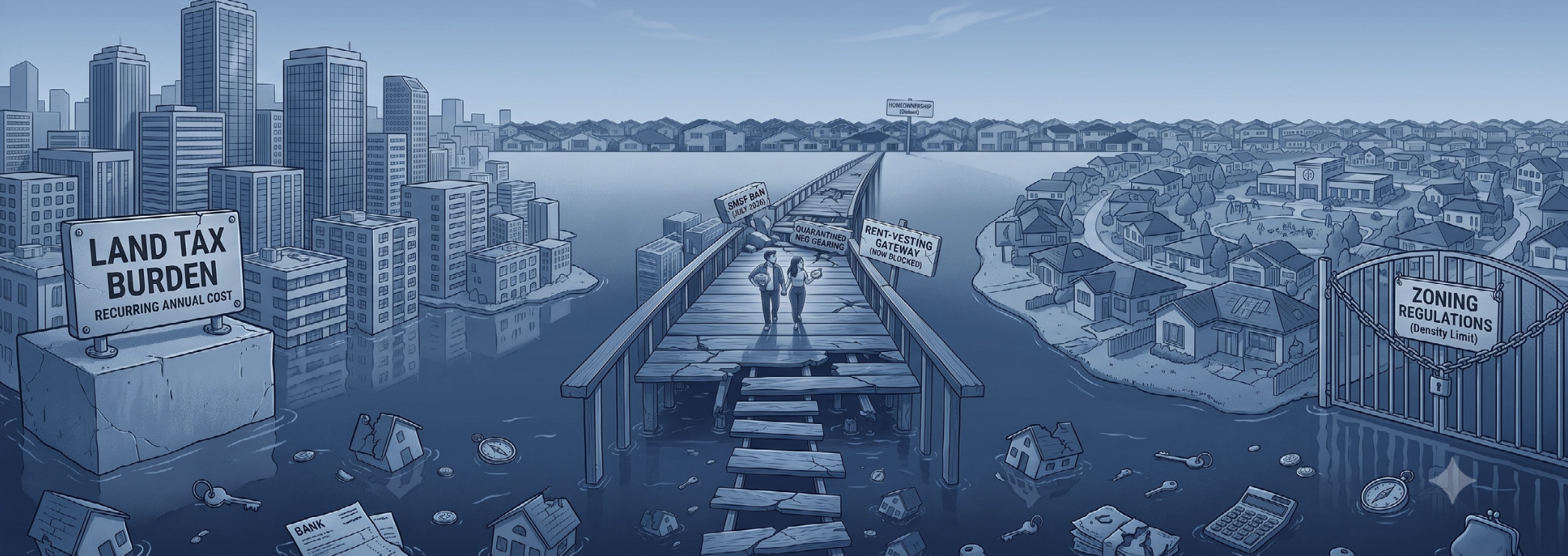
The Affordability Illusion: How Australia’s 2026 Property & Investment Tax Reforms Disrupt the First-Home Buyer Pipeline and Constrain Supply
The passage of the Treasury Laws Amendment (Tax Reform No. 1) Act 2026 and the Income Tax Rates Amendment (Tax Reform No. 1) Act 2026 (together The 2026 Tax Reforms) represents a major shift in Australian real estate taxation and superannuation policy. Positioned by policy architects as a progressive intervention to “level the playing field” for first home buyers by curbing investor demand, independent economic and legal analysis reveals a starkly different transmission mechanism.
Rather than smoothing the path to homeownership, the interaction of quarantined negative gearing on established dwellings, the replacement of the flat 50% Capital Gains Tax discount with CPI based indexation, and the sudden ban on Self-Managed Superannuation Fund residential borrowing risks restricting the entry pathways used by young buyers.
This analysis demonstrates why the “new build carve out” is unlikely to achieve its intended objective. While The 2026 Tax Reforms preserve full negative gearing and the 50% capital gains tax discount for newly constructed dwellings in an effort to protect housing supply, the concession does not adequately address the commercial realities of residential development. First, the grandfathered tax treatment applies only to the initial purchaser of a newly built dwelling. Once that property is resold, subsequent purchasers are subject to the less favourable tax regime, reducing the property’s expected resale value or “terminal value” from the moment it is acquired. Second, new developments are not valued in isolation. Banks and valuers assess unbuilt apartments by reference to recent sales of comparable established dwellings. As investor demand weakens and established property values soften under The 2026 Tax Reforms, the valuations underpinning new developments also decline. Lower GRVs erode development feasibility, making it more difficult for projects to satisfy lender financing requirements and ultimately reducing the supply of new housing
Download PDFLatest on Twitter

Our latest research argues Australia's 2026 property tax reforms may unintentionally:
• Weaken rentvesting
• Reduce apartment pre-sales
• Lower development feasibility
The result?
Read the research:
#Property #RealEstate #Housing #Development
Everyone’s watching interest rates. Fewer are watching trade policy.
US tariffs are reshaping construction costs, housing supply and rental yields across Australia — and splitting the market in two.
This isn’t cyclical. It’s structural.
https://shar.es/agEdkW
#AustralianProperty
Behind the Server: A Contrarian View on Data Centre Investment | Trident Real Estate CapitalTrident Real Estate Capital http://bit.ly/41DVYlN #DataCenters #RealEstateInvestment #TechInfrastructure #CommercialProperty #ContrarianInvesting #PropTech